
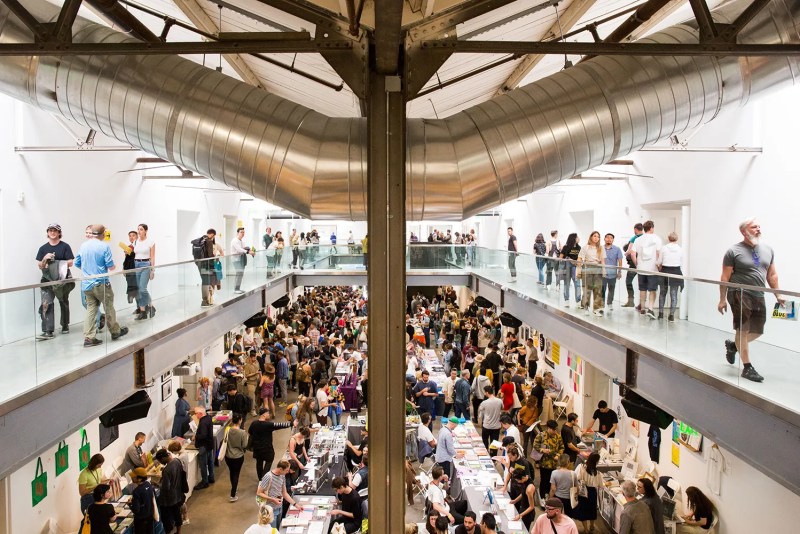
Photo by Airyka Rockefeller courtesy of Minnesota Street Project.
During SF Art Week, when art fairs often compete on scale, exclusivity, and ticket price, a new fair in Dogpatch is taking a different approach.
ATRIUM runs January 22–25, 2026 at Minnesota Street Project (MSP). The inaugural fair is free, Bay Area–focused, and embedded within a campus that has spent the last decade supporting San Francisco galleries through rising rents, shifting collector behavior, and a changing art market. Alongside the ground-floor booths, visitors can also explore MSP’s resident galleries (open throughout) and SKYLIGHT ABOVE upstairs, a group exhibition highlighting artist-run and experimental projects.
We spoke with Aimee Le Duc, Executive Director of MSP, about why ATRIUM is launching now, who it’s for, and what it looks like to design an art fair around access rather than barriers.

Photo courtesy of Minnesota Street Project.
Questions are in bold. Responses are by Aimee Le Duc, Executive Director, Minnesota Street Project.
ATRIUM is embedded within Minnesota Street Project rather than staged in a temporary venue. How did that decision come together, and how does the MSP setting shape the experience of the fair?
The art market is going through a lot of changes, and galleries are facing significant challenges, but Minnesota Street Project is founded on the mission of supporting and amplifying the robust gallery scene in San Francisco, so creating a small, thoughtful art fair was a natural extension of that mission.
Minnesota Street Project is celebrating its ten-year anniversary this year. We have a long-standing reputation as a leader in the arts community. We are free and open to the public, and this openness will make this fair unique. Over the last decade, we have fostered relationships in a number of creative communities and built a large audience, so we wanted to tap into that to deliver the best outcome for ATRIUM participants.
Additionally, mounting a fair among the MSP galleries allows the fair participants to join our existing communities. Visitors will see the fair and walk into our resident galleries. It’s not a walled-off experience by any means.
At its core, what problem was ATRIUM created to solve—for galleries, artists, or audiences—that you felt wasn’t being addressed elsewhere during SF Art Week?
When MSP was established in 2016, the problem to solve was affordable space. Galleries were being pushed out of downtown and needed affordable rent to continue their work. Today, the challenges are not so simple, but we need to develop and support new collector communities while engaging with established collectors. We are looking to create new points of entry into the galleries that show people how to buy and collect new work. Traditional fairs have other objectives. Booth fees and ticket prices have become barriers for both galleries and collectors to engage. ATRIUM is working to change this.
This fair is not just about showing art—it’s about building the next generation of collectors and supporters.

Hiroshi Sato, courtesy of Marrow Gallery and Minnesota Street Project.
Minnesota Street Project already operates as a year-round hub. From your perspective, what does a concentrated moment like an art fair activate for audiences or galleries that ongoing programming doesn’t?
Although we are regularly one of the most visited arts organizations in San Francisco, people clear their calendars for SF Art Week. There are a lot of celebrations and happenings across the city. It makes sense to capitalize on that. The energy and heightened visibility provide focus and urgency, which is essential for a successful art fair. Collectors visiting FOG Design+Art might discover galleries at ATRIUM they’d never have found otherwise and possibly rediscover the galleries at MSP as well.
ATRIUM focuses exclusively on Bay Area galleries. Why was it important to keep the fair regional rather than bringing in outside exhibitors?
Although the galleries participating in ATRIUM are all from the Bay Area, SKYLIGHT ABOVE, is showcasing artist and curatorially driven projects from a number of places in California. It was important to us to feature the depth and breadth of the local ecosystem and to connect these. Bay Area galleries need Bay Area collectors.
ATRIUM and SKYLIGHT ABOVE are about celebrating what’s already here: the bold, the experimental, the community-rooted arts communities being supported by these galleries and Minnesota Street Project.

Courtesy of Morgann Trumble Projects and Minnesota Street Project.
During ATRIUM’s run, visitors can see the ground-floor fair, explore MSP’s resident galleries (open throughout), and visit the SKYLIGHT ABOVE group exhibition upstairs. How do you hope people navigate those different layers—and what does having them all active at once add to the overall experience?
Minnesota Street Project has always had an open and welcoming spirit. We are free and open to the public and there are any number of ways to experience the campus. ATRIUM and SKYLIGHT ABOVE are an extension of that spirit. We will have food and beverages, Minnesota Street Project Foundation will be open and showcasing an exhibition. There is a lot to experience on the MSP campus. We encourage visitors to wander and discover artists and galleries on their own but events like ATRIUM also create opportunities for galleries to connect with new collectors and SKYLIGHT ABOVE is intentionally different. You’ll find artist-run, experimental counterpoints to the fair booths. There are reasons to come to Minnesota Street Project, reasons to stay, and reasons to come again!
Who did you have most in mind when shaping ATRIUM—and how did that audience influence decisions around scale, pricing, and programming?
ATRIUM is our way of looking forward. These fairs are our way of exploring new models of supporting artists, showing artwork, and connecting with first-time visitors and emerging collectors. We are seeking out people who’ve been curious but never felt the ‘gallery world’ was for them. The scale of the fair is very accessible. 20+ galleries is big enough to be exciting but small enough to not be overwhelming.

Photo courtesy of Minnesota Street Project.
Participating in any fair requires time, labor, and financial commitment from galleries. How did those realities shape ATRIUM’s structure—from being free to the public to how booths and programming were designed?
Minnesota Street Project is always going to be free and open to the public and that is the same for this fair. We’re conscious that booth fees at major fairs can be prohibitive for small and mid-size galleries to participate so we created a model to lower that barrier. This is the first year of hopefully many that we will be able to build and grow this fair.
Lastly, do you envision ATRIUM becoming an annual part of SF Art Week? If so, what elements feel essential to keep consistent as it grows (and is staying rooted at Minnesota Street Project part of that long-term vision)?
Yes, we are committed to hosting this fair annually, but keeping the model nimble enough to evolve and adjust as the needs of the art communities we serve evolve and adjust. Our framework is rooted in creating bridges between galleries and audiences, creating and growing relationships with new and seasoned collectors alike, and creating a campus-wide experience that is compelling for the participating artists, gallerists, and visitors alike.
ATRIUM doesn’t position itself as a replacement for traditional art fairs. Instead, it offers a reminder that collecting, showing, and supporting art doesn’t have to start with a ticket price or an insider network.
By grounding the fair within Minnesota Street Project’s existing ecosystem—and keeping it free, local, and intentionally scaled—ATRIUM proposes a different way forward: one where curiosity is welcomed, galleries are supported, and new collectors are invited in rather than priced out.
Whether that model expands or stays deliberately small, ATRIUM makes one thing clear: how we gather around art matters as much as the art itself.
Know before you go
ATRIUM
Minnesota Street Project
1275 Minnesota Street, San Francisco, CA
Schedule
Register to Attend (free)
- Public Reception: Thursday, January 22: 6PM-9PM
- Fair Hours:
- Friday, January 23: 11AM-6PM
- Saturday, January 24: 11AM-6PM
- Sunday, January 25: 11AM-5PM
Participating Galleries
1599fdT • Cruise Control Contemporary • Electric Works • Et al. • Euqinom Gallery • Gallery 16 • Glass Rice • Good Mother Studio • Incline Gallery • jane galerie • Jonathan Carver Moore • The Jones Institute • K. Imperial Fine Art • The Last Straw • Marrow Gallery • Morgann Trumbull Projects & 45th Street Editions • Pacific Saw Works • PALLAS • PARTS PECULIAR • Public Land Store + Gallery • Romer Young Gallery • Small Works Projects • The Space Program San Francisco • Telematic Media Arts
More info: atriumfair.com